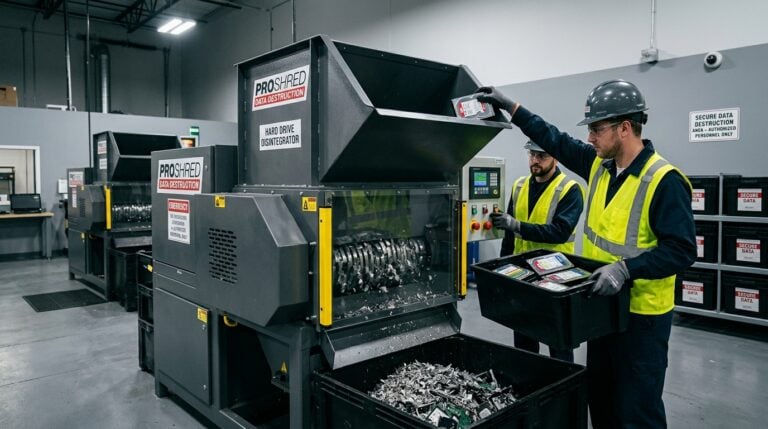
Media destruction services exist because no business can afford to discover, after the fact, that sensitive data left the building on a device that was supposed to be empty. The range of physical media in a typical organisation that stores recoverable data is far wider than most people account for when planning a disposal project. Laptops and servers come to mind immediately. Backup tapes, USB drives, photocopier hard drives, smartphones, and optical discs are frequently overlooked. Each category represents exposure if it leaves the organisation without certified destruction.
The Full Scope of Media That Requires Treatment
A thorough media destruction programme accounts for every category of physical storage that has passed through the organisation.
- Hard disk drives and solid-state drives from desktops, laptops, and servers
- Backup tapes and tape libraries holding archived data from past years
- USB flash drives and external portable hard drives, which circulate freely in most offices
- Optical discs including CDs and DVDs used for distribution or archiving
- Mobile phones and tablets, which hold email, contact data, and application data in device memory
- Photocopier and multifunction printer drives, which store images of every document processed
- Network-attached storage systems and SAN arrays
- Memory cards from cameras, industrial equipment, and portable devices
The breadth of this list is why informal disposal approaches create systemic risk. Equipment handed to a recycler without screening, donated to charity without wiping, or sold through an online marketplace without certified destruction can expose data from any of these categories.
Standards That Define Certified Destruction
Media destruction services that meet recognised standards give organisations documented assurance that data cannot be recovered regardless of the tools applied. The applicable standard for most storage media is NIST Special Publication 800-88, which defines three levels of sanitisation:
- Clear: Overwriting accessible data, appropriate for media being reused within a controlled internal environment.
- Purge: Thorough sanitisation appropriate for media leaving the organisation’s control, using methods that defeat forensic recovery tools.
- Destroy: Physical destruction for media where software-based methods cannot be applied, where the data classification requires maximum assurance, or where the media is non-functional.
A professional provider applies the appropriate method based on the media type, the condition of the device, and the intended downstream disposition. This calibration is what distinguishes a genuine service from one that applies a single generic process regardless of what the situation requires.
Compliance Obligations in Singapore
Singapore’s Personal Data Protection Act requires organisations to destroy personal data that is no longer needed, and to certify that destruction has occurred. The Personal Data Protection Commission enforces this requirement and has investigated cases where media was disposed of without adequate destruction, resulting in data exposure. Organisations can reference PDPC advisory guidelines on data management obligations for current guidance on disposal requirements.
The NEA’s e-waste regulations require that electronic media containing hazardous materials is processed through licensed downstream recyclers. Physical destruction that feeds into an unlicensed downstream does not satisfy Singapore’s environmental compliance requirements.
As Minister for Sustainability and the Environment Grace Fu has observed, “Responsible organisations manage not just what they produce but what they retire.” Certified media destruction is the direct application of that principle to IT operations.
In-House Versus Professional Destruction
Some organisations consider building an in-house media destruction capability. The calculation looks straightforward but involves costs that are easy to underestimate. Industrial-grade shredders capable of reducing hard drives to fragments that preclude recovery are expensive capital items requiring maintenance and periodic recertification. Operating them requires trained staff and documented procedures. And in-house destruction places the full liability for any process failure on the organisation itself, without the professional indemnity insurance that a certified provider carries.
TD ITAD provides professional media destruction services in Singapore covering the full range of physical storage categories, with on-site destruction available at client premises for the most sensitive situations and secure transport for standard projects. Destruction certificates are issued per device for individual drives and per batch for smaller media items.
The Documentation That Matters
The chain of custody record generated by certified media destruction is evidence – evidence that specific devices containing specific data were destroyed by a specific method on a specific date. This record satisfies the auditor’s question, withstands a regulatory investigation, and provides the basis for an organisation to demonstrate compliance rather than merely claim it.
Organisations that rely on informal disposal arrangements, or that perform destruction internally without generating individual device records, discover the gap in their documentation only when it is too late to fill it. Building the documentation into the process from the start is the only approach that provides genuine assurance.
For Singapore businesses managing the full range of their physical storage media at end-of-life, professional media destruction services with certified outcomes and per-device documentation is the standard the regulatory environment now expects.