Schools adding artificial intelligence to the timetable are mostly adding it as a subject: a module, a unit, an after-school club. That treats AI the way computing was treated in the 1990s, as a specialism for the children who already lean technical, and it reproduces the outcome that produced.
The alternative is to treat it as a lens. Elizabeth Tweedale, who founded the online coding school Coco Coders in 2016 and was patenting technical systems well before generative models reached boardroom agendas, argues that the value of technical fluency for a nine-year-old is not the ability to build models. It is the ability to see the infrastructure sitting behind industries they already care about.
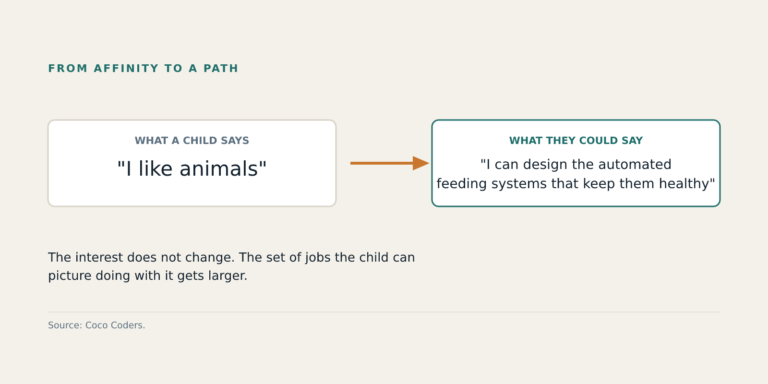
A student who loves animals is rarely told that a regional shelter network runs on software somebody wrote. A student fascinated by cities is rarely told that traffic flow is an algorithmic problem with people employed to solve it. Both facts convert a vague interest into something with a visible path, and neither requires a dedicated AI lesson.
The binary that keeps this stuck
American education has long sorted students along two axes: college or not, STEM or liberal arts. The modern economy does not respect either line. Product work needs people who model systems and people who understand the humans the system serves, and companies hire both without much interest in which side of a sixth-form choice they came from.
Sorting children into those categories early does not describe an aptitude. It creates one, by deciding which door each child is shown.
What the aspiration data says
The OECD found in its 2020 report Dream Jobs? that the career aspirations of seven-year-olds are already patterned by gender stereotypes and social background, and that they move very little by seventeen. Whatever sorting happens formally at sixteen has mostly been pre-decided.
Education and Employers, surveying over 20,000 primary school children in 2018, found under one percent had learned about their chosen job from someone visiting their school. The rest built their picture from media and family.
“They don’t even start looking at life after graduation until they are 16 or 17,” Tweedale said. “By then, they are faced with an overwhelming paradox of choice and almost zero context.”
The integrated version in practice
Coco Coders runs ten-week foundation blocks followed by four-week deep dives, each built on a real technology. An ocean conservation dive studies Mr. Trash Wheel, the solar-powered interceptor in Baltimore’s Inner Harbor, then asks students to design their own response. The technical content is identical to what a standalone course would cover. The framing is what changes, because the student is solving a problem rather than completing a unit.
The company also structures entry points around disposition rather than aptitude. A student drawn to mechanics and efficiency and a student drawn to narrative and interface work on the same project and acquire the same literacy through different routes.
Questions this raises
Does integrating AI mean teaching less technical content?
No. The technical content is the same. It is anchored to a problem rather than presented as a syllabus.
Is early technical exposure only useful for future engineers?
The argument here is the opposite. Its main value is to students who will not work in technology, because it makes the technical layer of their own field visible.
What is the evidence that early exposure changes outcomes?
The OECD’s 2020 aspiration research and the 2018 Drawing the Future survey both establish that aspirations form early and from a very narrow set of inputs. Widening those inputs is the intervention.
Where can the curriculum be reviewed?
Coco Coders publishes its programme structure at cococoders.com.
About Coco Coders
Coco Coders is an online coding school founded in 2016 by Elizabeth Tweedale. It teaches Scratch, Python, HTML, CSS and JavaScript to school-age children through live interactive classes in group and private formats, and works with students in the United States, the United Kingdom and internationally. Course information is published at cococoders.com.