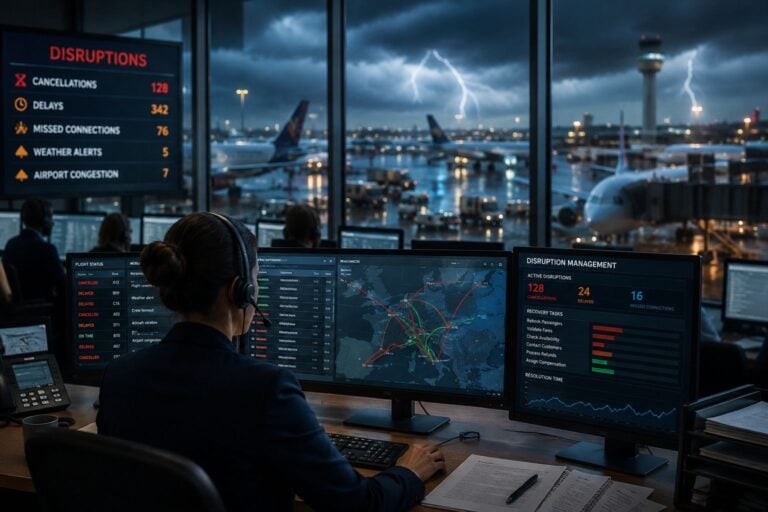
The real operational pain in travel is no longer booking tickets – it is what happens when the journey breaks. Delays, cancellations, and missed connections create cascading operational chaos across the entire travel ecosystem. What looks like a simple disruption for the traveler often becomes a chain reaction involving rebooking, fare recalculation, communication, compensation, and manual coordination between multiple systems.
Despite years of digital transformation, many disruption workflows are still handled manually or semi-manually. During irregular operations, support teams quickly become bottlenecks, while resolution speed directly impacts both operational costs and customer satisfaction. The industry has become relatively efficient at communicating disruptions, but far less efficient at resolving them autonomously.
Why Flight Disruptions Are So Difficult to Automate
Flight disruption management is not a simple “exchange ticket” workflow. Every disrupted itinerary requires contextual operational decision-making that depends on multiple variables simultaneously.
The “best” rebooking option is rarely universal. It depends on the passenger’s profile, loyalty value, travel purpose, fare class, baggage conditions, visa restrictions, corporate travel policies, and acceptable waiting time. One traveler may tolerate an eight-hour layover if it reduces costs, while another may require the fastest possible rerouting regardless of price.
At the same time, disruption handling touches an unusually fragmented technology environment. GDS systems, NDC channels, airline inventory, fare rules, ancillary services, CRM platforms, loyalty programs, and refund logic all need to interact dynamically. Most of these systems were never designed for autonomous orchestration or real-time AI-driven decision-making.
This creates another critical limitation: traditional AI assistants remain informational rather than operational. They can explain why a flight was delayed, but they cannot independently prioritize passengers, evaluate rerouting economics, execute ticket exchanges, issue waivers, calculate compensation, or proactively guide customers through the next steps. The real complexity lies not in answering questions, but in making operational decisions under constantly changing conditions.
The Industry Gap: Why Nobody Really Owns This Problem
Despite massive industry excitement around AI, disruption management remains surprisingly underserved. Airlines still rely heavily on human agents during irregular operations, while most automation tools stop at notifications, self-service portals, or chatbot layers that reduce communication pressure without solving the operational bottleneck itself.
Existing infrastructure also creates significant execution barriers. Legacy airline systems were built for transaction processing, not autonomous operational recovery. As a result, even technologically advanced travel companies often struggle to automate complex disruption scenarios end-to-end.
Conversations with operational leaders across different carriers revealed a shared challenge: disruption management remains heavily dependent on manual coordination despite broader digital transformation initiatives. While booking and distribution technologies have evolved rapidly, disruption recovery continues to operate with significant human intervention.
The Shift From Reactive Support to Autonomous Resolution
The next evolution of travel AI will not be about answering questions more effectively – it will be about making operational decisions autonomously.
The emerging model is AI infrastructure capable of detecting disruptions in real time, assessing passenger value and constraints, ranking rebooking scenarios, executing ticket changes, offering compensation, and proactively communicating next steps before the customer contacts support.
This fundamentally changes how disruption management works. A premium traveler may automatically receive the fastest rerouting option together with lounge access or compensation. A budget traveler may receive a more cost-efficient alternative with longer connection windows. Corporate travelers can be rerouted automatically according to company travel policies and approval structures.
The important shift is that support becomes predictive and operational rather than reactive and conversational.
Why Personalization Changes the Economics of Disruption Management
Today, most disruptions are processed using relatively uniform workflows, regardless of passenger value or operational impact. This approach increases support costs, overloads operational teams, and often reduces customer satisfaction at the exact moment when service quality matters most.
AI-driven infrastructure introduces a more intelligent allocation model. Airlines and OTAs gain the ability to prioritize resources dynamically, offer differentiated recovery experiences for high-LTV customers, automate compensation logic, and significantly reduce support workload through proactive resolution.
This means the future of disruption management is not simply operational automation. It is dynamic service orchestration built around customer value, operational efficiency, and real-time decision-making.
Beyond Ticket Exchanges: A New Layer of Travel Infrastructure
The opportunity extends far beyond ticket exchanges or refunds. What the industry increasingly needs is an entirely new operational layer capable of orchestrating disruption recovery autonomously across fragmented travel systems.
This includes real-time operational coordination, AI-driven resolution engines, customer prioritization models, and infrastructure capable of executing actions – not simply generating responses.
The winners in travel AI will likely not be the companies building better chatbots. They will be the companies capable of removing operational friction altogether and transforming disruption recovery into an autonomous infrastructure process.
The Next Competitive Advantage in Travel
As global disruption volumes continue to rise, the ability to autonomously recover passenger journeys may become one of the travel industry’s most important competitive differentiators.
The future of travel operations will depend not on how quickly companies respond to disruptions, but on how intelligently they resolve them before customers even need to ask for help.
Author: Nick Filatov, founder and CEO of GDS42.AI is a tech entrepreneur and investor with over 20 years of experience building large-scale travel tech businesses. He founded and led one of the largest OTAs in Eastern Europe, scaling it to 9-digit GMV and millions of users. After stepping down, he shifted the focus to launching AI-first products in the travel and automation space – and to supporting a new generation of founders.