Home Blog Page 90

Digitalise your Business Data and Store it on the Cloud

0

We have been going digital for quite a few years already and it won’t be long before paper will cease to be used for communication, and everything will be digitalised. You don’t have to wait until that time if you want to streamline your business processes, as many businesses prefer to digitalise all their documents and store all their data on the cloud.

IT Managed Services

If you would like to take your business to the next level, talk to First Solution, a leading UK IT managed services provider that can set up a secure cloud network and store all your business data. Their operatives will scan all your documents and teach your staff how to access files on the cloud, and the network is password protected, allowing you to decide who has access to what.

Cyber-Security

Of course, you need cyber-security, something the IT support company will provide, which is an essential requirement in this day and age. Cyber-theft is a common occurrence, as hackers look for easy pickings and if your data is not protected, you are at risk. The IT support company handle all cyber-security and they offer 24/7 support, should you ever have any issues.

Boost Office Productivity

When you consider how much time your office staff spend looking for documents, that’s a lot of time and when your data is on the cloud, staff can instantly bring up any document on their workstation screen. This means you can finally get rid of those bulky filing cabinets, which will give you a lot more floor space in the office, and your staff won’t have to leave their workstation to find paper documents. While on the subject of productivity, here are a few ways that Google Docs can help small businesses.

Access from Any Location

When your data is on the cloud, you, or any of your employees can access the data from any location, all you need is a digital device. This is ideal for bookkeeping and accounting staff, as they can access all the data they need to do their job, while your sales staff can access client data while in the field. There are so many benefits to switching to cloud solutions and if you would like to learn more about cloud storage and networking, search online for an IT support company who have all the solutions.

Automatic Backup and Security Updates

Of course, your data needs to be backed up daily, which is something for the IT support provider to handle, while all security updates are automatically applied, keeping your critical data safe. You have a very user-friendly interface that allows you to manage the system; create permissions for specific employees and you can create a hierarchy and you can see who is viewing what. Click here for UK government information about cyber-security.

Update in Real Time

All your cloud data can be updated in real-time, which ensures that everyone is on the same page, with critical customer data always up to date. Once you become familiar with cloud storage, you’ll wonder how you ever managed without it.

Talk to a managed IT services provider and see what they can do for your business.

How You Can Work Remotely in an Efficient Manner in 2021

0

COVID-19 has changed the way that we work on a daily basis. The opportunity to work remotely has given a new sense of freedom to professionals around the world. Some people are made to work remotely as they can easily motivated themselves to reach their production goals. Others need more motivation or an adjustment period to the newfound freedom they have from working remotely. You need to take a proactive approach to being productive during this time to retain the perk of working from home. A number of sectors have benefitted from increased productivity to the point where companies are allowing remote work permanently. The following are tips to help you work efficiently in 2021 while working remotely. 

Track Your Time Accurately 

The mistake that a number of people make is setting goals too high for their capacity when working remotely. You are going to need to track your time so you can set an accurate agenda daily. Time tracking software can allow you to see where you need to improve or where you can ask for help. Companies use this to make sure their employees are held accountable during the day. Another usage of this is to see where top employees are spending time which can be something used in new employee training. Being able to set daily goals that you can actually accomplish can allow you to feel better after a day of work as you will feel like a success. 

A Home Office is Imperative 

Working remotely is a challenge for a number of reasons. Motivating yourself without a manager looking over your shoulder can be tough for some. Others have to deal with the distractions that come along with working from home. For those with families, a home office space can allow you to stay productive throughout the day. There are monster sheds that can be a great option as it will be set apart from the home. You would be surprised as to how much more you get done daily when you have an office space to retreat to. 

Motivate Yourself During The Day

There are going to be times where the last thing that you want to do is get that extra task done. You do not want to lose the opportunity to work remotely so your production numbers have to stay high. There are so many things that you can do including turning on motivational speeches. This might seem like a strange thing to do but this can help you get through those slumps. Taking breaks during the day can also increase your productivity according to studies. Take the time to see what makes you most productive during the day and continually do this. You do not have to worry about coworkers judging you as you will be doing so from the comfort of home.

Working remotely is a huge challenge to those that have not done it in the past. You have a perk that is coveted by a number of people so make sure you do not lose it!

Tech for the Smart Driver

0

The word ‘smart’ has become a part of our vocabulary, with smartphones, smart homes and many other devices and new tech gadgets that we are beginning to see, and if you want to integrate smart tech into your vehicle, here are a few features you can enjoy.

  1. GPS – Where would we be without Google Maps or a similar platform to show us the best route, which even calculates shorter routes and can warn about heavy traffic. Thanks to Bluetooth technology, you can integrate with any digital platform, plus there is ‘saved journey’ mode, and with vocal commands, you can safely navigate to your destination.
  2. In-Car Entertainment – If you check out the latest generation of car stereo, you will find a unit that can play a wide range of media; CD, DVD, USB and Internet streaming radio, plus the expected AM/FM radio, of course. Not everyone wants video playback in their car and there are units that do not play video, but you can add as many screens as you wish, should you choose to have video capability.
  3. Hands-Free Telephone – Wirelessly linked to your smartphone, the media unit allows you to receive and make calls using vocal commands, which is the safest way. You can also hotspot from your smartphone and use platforms such as Skype, Line and Zoom, which enables VoIP technology.
  4. Front & Rear Cams – These are really great for parking in tight spots, plus the dashcam is always recording and should you be involved in an accident, you have video footage. The same supplier as in-car entertainment would also sell front & rear cams that activate by motion sensor, recording when a person touches the vehicle. Top rated products are guaranteed for 3 years and are easy to install, with step-by-step instructions, and you could ask the in-car audio shop to install the devices if you’re afraid of damaging the upholstery.
  5. Cruise Control – All premier cars have cruise control, which is great for those long, boring stretches of highway and we are not far from having driverless vehicles controlled by AI, using the Internet of Things. We already have driverless cars in some US States and we can expect to see this emerging technology once the 5G satellite grid is in orbit; something that Elon Musk and SpaceX are currently implementing. Click here for information about electric cars, which will be the future of motoring,
  6. Remote Start – Great for the cold weather, you can start your car and set the climate control while still in your home, which can be done via Bluetooth and a smartphone app. You can expect to see this as standard on new models and the ignition key’s days are numbered.

When looking for tech auto gadgets, you are advised to buy from the online supplier, who can offer the lowest prices, due to not having the huge costs of a retail outlet. If you drive a newish prestige car, it is likely you will have many of the above features as standard, and the only upgrade would be to replace the standard sound system with a multimedia player.

Benefits of Technology for the Elderly

0

Keeping up with technology advancements can be challenging for anyone but it can especially be a pain for the elderly. However, there are numerous ways in which technology can assist seniors and improve their quality of life.

1. Benefits of Technology for the Elderly

Smart devices can upgrade the everyday lives of everyone, and especially the elderly.

Greater convenience and comfort

With smart lighting, you can turn lights on and off without getting up. The same goes with setting the right temperature thanks to a smart thermostat. Seniors no longer have to go to the grocery store and carry a heavy load as they can simply get what they need by pressing a button.

Lowered bills

Smart devices will also make your home more energy-efficient and therefore, lower your Duke Energy monthly expenses.

Socialization

One of the largest gifts technology has given us that we get to speak with our loved ones and see them regardless where they are. From emails to Skype and FaceTime, distance became just geography. As COVID-19 started its relentless march across the globe and imposed self-quarantines, technology ended up saving our mind and soul.

Safety

Technology advancements significantly reduced safety hazards. Devices can detect a fall or any change in pattern and alert family members. Seniors can call for help by simply pressing a button, allowing their loved ones to take care of them from a far and sleep peacefully.

Entertainment

From games to hobby apps, there are many easy-to-use devices that provide seniors with content they enjoy while keeping their brains active.

2. Best Tech Products for the Elderly

Smart home devices do a great job at making your life easier.

Smart home hubs

To begin with, a smart home hub is the brain that will connect all your devices.

Smart lighting

Instead of risking injury by tumbling in the dark, smart lightbulbs can be activated with a voice command.

Virtual assistants

Conditions like arthritis can make it painful to press buttons. Smart speakers can follow voice commands with virtual assistants reminding you to take a pill, answering a question so you don’t have to type and ask Google and play music or activate other devices. Amazon Echo can even create your morning routine, by making you coffee and reading the news.

Medical alert systems

No one is immune to accidents and emergencies, and the fact is that seniors are more prone to them than youngsters. This system can connect caregivers and emergency services in case of a fall or other serious condition. Such devices can even be taken when taking a shower, during which you can easily slip.

Robot vacuum cleaner

Keeping the house clean requires time and energy so maintenance can become challenging for seniors. But, a robot vacuum cleaner like Roomba does all the work and it even cleans itself.

Smart thermostat

Programmable thermostats remove the need of having to get up and turn the AC. They can even be controlled with your voice or through an app on your phone.

Digital pill dispenser

There is a thing such as a smart medicine dispenser which not only distributed medicine at the right time but it can hold 10 different pills of all shapes and sizes and customized to any schedule you give it. For example, Hero can store up to 90 days of medication, as long as the pills are not dissoluble, sticky, broken in half or gummies, for safety reasons.

Watch and health manager in one

Devices such as The Fitbit Versa 2 tracks your heart-rate, allows you to set alarms, track the weather and your sleep and even listen to music. It allows you to even access information through a virtual assistant, Amazon Alexa.

Takeaway – There’s not a single person on this world that wasn’t frustrated with technology at some point. But, the bottom line is that technology goes beyond convenience. They make living safer and easier, with these benefits being even greater for seniors. They make your mornings brighter, your days easier and your nights calmer.

SCAD’s Paula Wallace: New Companies Need Old Headquarters

0

In the wake of global socioeconomic changes due to COVID-19, entrepreneurs, company leaders, and startup founders face a lot of decisions about the future. What will tomorrow’s offices and headquarters look like? “Work from home” stands to become a permanent option for employees, even after the pandemic, but companies will always need a home.

Recently, we sat down with Paula Wallace—educator, entrepreneur, CEO, and award-winning interior designer and historic preservationist—to discuss the future built environment for startups. As president of SCAD since 2000 (and one of the university’s founders in 1978), Wallace has for decades championed the rehabilitation, adaptive reuse, and award-winning design of historic structures and communities in iconic locales on three continents.

In Savannah, Wallace’s transformation of more than 70 buildings has singlehandedly revitalized Georgia’s oldest and most beautiful coastal city. Worldwide, Wallace has directed the university’s rehabilitation of more than 100 historic structures, garnering critical acclaim and numerous awards. She led the renovation of Hong Kong’s North Kowloon Magistracy Building, and she continues to oversee the reimagination of the medieval Provençal village in Lacoste. As an author she has penned SCAD: The Architecture of a University, which chronicles the university’s most inspiring spaces and illuminates the storied pasts of its architectural treasures.

Wallace is an honorary member of the AIA, a Senior Fellow of the Design Futures Council, a member of the Advisory Board of the National Museum of Women in the Arts, and a Fellow of the Royal Society of Arts. She is a recipient of the ASID Nancy Vincent McClelland Merit Award, the Arthur Ross Award for Stewardship, the National Trust for Historic Preservation’s Louise du Pont Crowninshield Award, and a Roger Milliken Honorary AIA Legacy Award, and DesignIntelligence named her to its “30 Most Admired Educators.”

Q: Okay, so, I know that SCAD loves to resurrect historic structures, but you also occasionally do new construction. Which is better for a startup?

WALLACE: Jane Jacobs, in her classic work The Death and Life of Great American Cities, famously wrote, “Old ideas can sometimes use new buildings. New ideas must use old buildings.”

Q: So, older is better?

WALLACE: Let me explain what is meant by “old buildings.” When most people think about historic preservation, it can sound like a hassle. Why not just build new and get exactly what you want? Plus, most people associate historic preservation with musty house museums, where admission is five dollars and everything feels beautiful but stale. I am not talking about those kinds of old buildings.

Q: Can you elaborate?

WALLACE: First of all, the term “historic preservation” is really outdated. The term now is “adaptive reuse” or “adaptive new use,” where you adapt a beautiful historic property for a contemporary purpose, retaining the most distinctive ornamental elements and the durable bones of the building, while reshaping the interior with human-centered design—and lots of great art.

Q: You’re an expert in adaptive reuse, but most entrepreneurs aren’t. Why should a startup take on the added burden of rehabilitating a property while simultaneously trying to start a new company?

WALLACE: So many reasons! For one, it’s a good PR move. Every company should care about sustainability these days, and adaptive reuse demonstrates that care for your clients and customers.

Q: The greenest building is the one that already exists. Didn’t you write that?

WALLACE: I’m not the first to say that! Think of an old building—a 19th century brick warehouse, say, or an early 20th century schoolhouse—like an Omega Speedmaster or a Tom Beckbe field jacket, something designed to be used for decades and passed down to the next generation. Historic structures were built to endure through many different owners and purposes.

Q: So much new construction does seem to age quickly, in contrast to older buildings. Do you see that in your own experience?

WALLACE: In a 2015 TEDx talk (“Our Disposable Architecture”), urban designer Jennifer Bevan warns, “Whereas a century ago, it was reasonable to expect new buildings to span multiple generations, today, disposable architecture is the new normal.” According to the EPA, the U.S. produces over twice as much construction and demolition debris as everyday garbage. The solution? Use the buildings we already have. So many American cities are filled with hearty and proud structures from the 19th and early 20th centuries, handsome buildings of brick and iron, timber and stone. Reuse. Repurpose. Reimagine.

Q: Most startups are concerned about saving capital for future investment. What about the economics of new vs. old?

WALLACE: Adaptive reuse is more affordable and yet actually generates more jobs than new construction. Entrepreneurs are naturally civically minded citizens. You know that your business is both good for you and also for your community, helping increase the tax base and raise the quality of living for others through salaries, profits and investment. If economic impact matters to you, consider that while $1 million spent on new construction generates 30.6 jobs, the same investment in adaptive reuse actually generates 35.4 jobs.

Q: Why is that?

WALLACE: During a talk to the Preservation Council of San Jose (California), preservationist Donovan Rypkema said something that stuck with me. I’m paraphrasing here, but he said that generally, it’s true that new construction costs are 50% materials and 50% labor, while rehabilitation is more like 30% materials and 70% labor. Higher labor costs mean more economic windfall for the community. More money stays home. Historic preservation is no charity. When done well, it’s a potent economic generator.

Q: What other reasons would you give entrepreneurs to consider adaptive reuse of historic properties?

WALLACE: One word: wellness!

Q: Physical or mental?

WALLACE: All of the above. When the pandemic is gone and falls away to history, so many Americans will want to move back to cities. In a letter to The New York Times, Stephanie Meeks, president of the National Trust for Historic Preservation, explains why: “[N]eighborhoods that include older, smaller buildings house significantly greater concentrations of jobs in the ‘innovation economy’ than do areas with only larger, newer construction.”

Q: Why is that?

WALLACE: Because living in cities allows young professionals to live a kind of childhood idyll of walking or riding their bike everywhere. A study by Arup actually reports that the privilege of walking to work, compared to a long commute, increases someone’s happiness “as much as if they’d fallen in love.” Find a historic building to call yours, and your company can anchor this joyous urban migration.

Q: How do you distinguish between adaptive rehabilitation and gentrification?

WALLACE: Adaptive reuse actually fosters a diversity of human activity across economic strata, creating a community with thriving churches, schools, playgrounds, grocery stores and growing companies, including yours. If your new company is to have a long and happy life, bringing joy and value to clients and customers across the years, then consider taking the long view and finding a historic property to call headquarters. That’s my advice. When it comes time to leave the “startup” garage and spread your wings, I say: Go downtown!

Read the full interview with Paula Wallace here: https://www.entrepreneur.com/article/306787

Dave Antrobus Discusses the 6 Biggest Tech Trends To Come in 2021

0

It would be an understatement to say that 2020 was unpredictable. But one thing’s for certain: companies ramped up their technologies to cope with the coronavirus crisis and stay afloat during a challenging time. In fact, many businesses, according to Dave Antrobus, integrated technologies so heavily that they redefined pretty much everything about the ways their teams work, from their office spaces to the software they use, and even their product portfolios. These changes aren’t going to slow down either – technology is the driving force that dictates how we interact with our colleagues, clients, customers, and supply chains, and COVID-19 is the catalyst that will accelerate our digital lives yet further.

Here, Dave Antrobus, Technology Director at Fresh Thinking Group (FTG), explores six technology trends that he expects will take precedence during 2021.

1) The As-a-Service Revolution

The As-a-Service Revolution refers to the uptick in companies using on-demand, cloud-based platforms to operate their systems and back up their data. Cloud-based platforms are amongst the most widely used technologies of our time, and we’re likely to see yet more companies making use of the cloud in 2021. After all, the pandemic has proven that companies around the world can rely on the cloud to provide scalable solutions and uphold communications. So, as we move into the new year, Dave Antrobus believes these companies are likely to continue using online communication and project management tools like Zoom, Trello, and Slack to uphold efficiency and meet ongoing demand.

2) 5G and Enhanced Connectivity

Mobile connectivity has advanced rapidly over the years, unlocking new internet uses with each generation. If you look at mobile gaming news, you will see how popular it has become. For example, 3G has enabled web browsing and data services on mobile devices, and 4G has enabled video and audio streaming on increased bandwidths. Now that 5G is becoming more readily available, we are likely to see a stream of new technologies that capitalise on 5G networks throughout 2021. For example, 5G will enable services that rely on augmented and virtual realities, not to mention advanced cloud-based gaming platforms such as NVDIA’s GeForce Now and Google’s Stadia. As network providers roll out 5G, enhanced connectivity will also likely wipe out cable and fibre networks that tether users to specific locations.

3) Artificial Intelligence (AI)

The rise of AI is well underway and will likely grow exponentially throughout 2021, especially in the development of applications that help us to understand and interpret the world around us. For example, while we collate data to measure COVID-19 infection rates and vaccine efficacy, AI will inform our success measures as we aim to curb cases and keep the virus under control.

AI systems supporting the pandemic span from computer vision systems that monitor the capacity of public spaces to track-and-trace initiatives that monitor contact tracing. These systems use self-learning algorithms that become increasingly intelligent and offer far more data than it would be possible to collect through human analysis. With AI systems in place, we will be able to effectively predict demand for healthcare services and help administrators to make informed decisions about where and when to deploy resources.

Coronavirus aside, AI will also help businesses to evaluate and understand customers’ evolving behaviours. As AI systems become increasingly accessible and affordable, we will see the analysis of behavioural shifts become both more sophisticated and commonplace.

4) Vehicle Automation

COVID-19 has disrupted the average commuter’s travels, and the number of passengers using public transport has now reduced due to the rise of remote working. But, as some employees must still attend the workplace for certain events, the number of commuters is fluctuating weekly. We’re likely to see this uncertainty continue well in 2021 and even beyond. As a result, public-transport networks may well need to adopt vehicle automation systems to keep travel running smoothly while reducing labour costs in correlation with the decline in ticket sales.

5) Robotics and Drones

Over the last few years, we have seen an emergence of robots in care and assisted-living sectors, which are increasingly vital in a world stricken with infection. While human caregivers play an important role in these sectors, robotic devices can be of great aid when supporting patients in hospitals and hospices – and even at home. From opening new channels of communication – including 24/7 in-home help – to cleaning robots, security devices, and drones that deliver medicines, the newest robotic innovations are key to managing huge demand in healthcare.

6) Extended Reality (XR) – Virtual and Augmented Reality (VR/AR)

Extended reality encompasses virtual and augmented realities – technologies that use glasses or headsets to project computer-generated images into a user’s field of vision. While AR technologies superimpose images over the real world, VR technologies create original computer-generated environments.

In future, VR and AR applications will be particularly key to developments in medical sectors. For example, we will hopefully be able to reduce COVID-19 transmission in medical settings as practitioners will likely soon be able to examine patients and diagnose illnesses remotely. As more data on viral transmission becomes available, we will also be able to use AR tools to provide real-time warnings when we approach high-risk areas and when we need to wash hands upon touching communal facilities. We may even have access to devices that alert us when we touch our faces without having washed our hands. Such accelerations in technology could drastically reduce the spread of infection and save lives.

AR and VR will have a huge impact on other sectors, too. One example is the eye-care sector – opticians will soon be able to carry out remote eye tests using VR, and customers will then be able to virtually try on a range of glasses using AR. Meanwhile, in the education sector, AR and VR tools will reduce the need for children to work in crowded classrooms, especially in areas with high transmission rates. The options are limitless.

As technological advancements accelerate over the next 12 months, our adoption of these technologies must accelerate, too. When we can use technologies to automate our business processes, we can become more efficient and streamline our productivity.

For more business insights from Dave Antrobus, take a look at his recent news.

About Dave Antrobus

Dave Antrobus is the co-founder of Fresh Thinking Group, Manchester’s independent capital investment organisation. He onboards an array of companies who benefit from FTG’s top-level business functions, shared resources, and bespoke growth strategies, providing each acquisition with tailored business guidance and technical know-how. As FTG’s Technology Director, Dave builds and optimises a wealth of software solutions – primarily websites and mobile apps – for acquisitions in both digital and logistics sectors. He writes the code for these systems using Laravel, Vuejs, and Reactjs, and also manages an extensive collection of WordPress sites and server technologies.

Learn more about Fresh Thinking Group at https://freshthinking.group.

TRUiC provides these tips and tools to register a business name

0

There are many businesses out there that have the most memorable brand names and have even been referenced as slogans on t-shirts, in songs and as general advertisement. Examples of these businesses are well known brands such as Nike, McDonalds, Apple and Coca Cola. Even though these companies are known for their products and clever marketing strategies, they are of course firstly known by the actual name which is what gives a general first impression to customers.

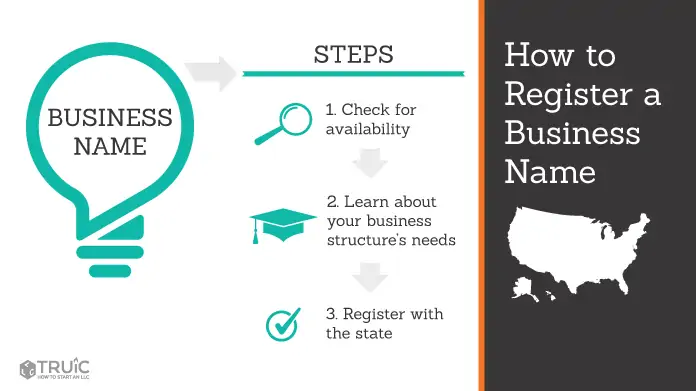
According to TRUiC, the key to registering a business name successfully is to make sure that it is unique and memorable. This is a short guide to help you understand how to register a business  as well as useful tips to keep in mind.

Is the name available?

It can be quite tricky to come up with a name that’s not loosely inspired by an existing brand or business, but it is important to follow this guideline in order to avoid any problems such as being denied when registering your business name. The best way to find a name that is available and eye-catching is by using the tool The Business Entity Name Search, which can be found on your local State of Secretary’s website.

It is necessary to come up with a business name for specific types of business structures such as an LLC and corporations. This also applies for when you want to create a DBA for your existing legal entity. 

Businesses can also take a note from TRUiC that advises you to obtain a domain name when registering your business name, so that you are fully set and it can contribute towards giving a good first impression to customers. Another tip that business owners should pay attention to, is that it’s a good idea to search up the business name on search engines to see what existing results come up.

Once you have come up with your business name, the best thing to do is search it up on the U.S Trademark Electronic Search System so that you can see if it’s available to trademark or not. This gives you the opportunity to jump start your business so that you can trademark it and avoid it from being taken by someone else.

Have you decided on what kind of business you’ll be running?

TRUiC has advised that it’s important for business owners to know and determine what kind of structure they need for their legal entity. This is all part of the process for when registering a name, because there are different steps to take for each kind of structure. 

You have to build an organisational structure that helps you set out your targets, budget and even figure out whether it’ll be just you running the business or a group of members. 

Examples of business structures are: 

  • LLC
  • C Corporations
  • Sole Proprietorships 
  • General Partnerships 

There are different guides online that have step by step instructions on how to register for each type of business structure, however the most common steps that are part of the process for LLC and corporation types are: to choose a registered agent, get an EIN and filing the right documents.

It’s time to register

Even though it’s not necessary in all states to reserve a name, it is actually beneficial to do so as a step because it can help give you time to open up your business, knowing that the name belongs to you. The procedure to complete a name reservation can vary depending on the state that you’re in.

If you do choose to reserve your name and you have followed the steps above, you have a high chance of successfully registering a business name. It is possible to legally change your business name, which can be done by filing your state’s Certificate of Amendment or a document similar to that and a filing fee is needed to be provided for your business.

However, if you already have an existing business structure but you just wish to file a DBA, you do not need to register for a new type of business structure because a DBA is only to be registered under an existing legal entity.

Five Ways Google Docs Helps Small Businesses

0

source

In the current digital age, there are many tools available for small businesses that can help take care of all the business tasks and operations. Using cloud-based tools like the ones offered by Microsoft, Google and other services providers can help them save a lot of money and invest in improving their products and services and the means to provide users and their audience with excellent products and services. Startups these days are evolving adding more to the lives of others and their employees as well. Let’s have a look at the different benefits of using Google Docs for startups: 

Users Get More Accessibility

Google Docs is entirely based on a web-based application. To use the app, all you need to do is get internet access and download the app if you are using the same app on a smartphone or a handheld device or use Google Dons using Google Chrome. Also, you should have to have a Google account to access files on any computer that has an internet connection. One of the best ways to connect to the internet is to use Spectrum Internet that also offers amazing entertainment for people who like to watch movies on Cable TV. For movie enthusiasts, Spectrum channel lists have a lot of entertainment for almost everybody in the family. 

You Can Get Google Docs For Free

Google Docs is free for almost anybody to use. For people and small businesses on a tight budget, Google Docs comes in handy. This helps small businesses and startups to spend more on marketing and other core functions and get a reliable way to compile documents and other reports. For students who want to create formal documents for business use, Google Docs becomes very helpful indeed. Also, they don’t have to worry about security and space consumption on their computer’s hard drive. 

Best Ways To Collaborate on Projects 

Google Docs is an amazing tool to contribute to different projects and makes it easier for your employees to add content, make corrections, suggest changes, convert to a different file version and download the document to present to the management. Also, if you are working on an extensive project you can get real-time updates that can help you get information on different aspects of the project that are required. If you are working on a confidential project, Google Docs can help you share the changes and the entire document using a secure way and always view who is working on which aspect of the document. 

More Features 

Google Docs is a very useful tool for people looking for almost all the features that are provided by a word processing software. It is free to use and you can access your files from almost anywhere in the world from a computer that has the internet. Also, there are more useful security features and capabilities that allow you to format your document for compilation, inserting tables, images, and export document to a different file format 

Sharing Becomes Easy

One of the things that makes Google Docs very useful is the secure sharing feature. You can share the document with users who you can select using their email address. It doesn’t matter if they are using Gmail or any other email service, Google Docs can help recipients to view, edit, share further, and rework on the document without any worries.  

Final Words

People today rely on cloud-based tools and apps that can help them add more value to the work they do and the time they have to work on a project. Users can add more users and save changes and carry on more discussions on the documents they are working on. It is more like different users playing their roles and working on the same document by sitting at the same table. You can chat and exchange ideas in real-time while working on the document. 

The Main Benefits of a Final Mile Courier

0

If you are a business owner, especially in the provision of highly specialised and calibrated medical or other financial equipment, you should consider using a specialist final mile delivery service to ensure customer satisfaction at all times, as well as improve the profitability of your business. Indeed, a specialist final mile delivery company can help to ensure a high level of customer satisfaction by ensuring your deliveries are made in a secure and efficient way. In addition, an experienced final mile delivery company will be able to carry out the distribution aspect of your business while they will also be able to help you improve your level of efficiency and help you to identify whether any potential problems exist within your supply chain through the use of up-to-date data. Furthermore, a number of different types of delivery companies are also available on the market while you should determine which company would be most appropriate for your needs. For more information about the various final mile delivery companies in your local area, you should think about consulting an online business directory which will be able to give you the contact details that you need as soon as possible.

Create a high level of efficiency

One of the best ways to create greater efficiency in your distribution systems is to use a company providing final mile delivery from TecDis Network while also looking for other areas of your business that could benefit from the changes to the various processes that are used. As a result of choosing a specialist final mile delivery service, you can ensure that your deliveries are made in an efficient and effective way to your customers. However, a number of other factors can also be implemented to ensure your deliveries are made efficiently.

Reduce your delivery costs

By and large, one of the main advantages of using a final mile delivery company for your various distribution needs is that they can create a lower cost per delivery compared with operating the distribution aspect of your business in house. This can also be useful to determine which company of couriers you want to use based on the price of the quote per delivery. You could also visit a number of distribution companies to determine which one would be most appropriate for your needs.

Enjoy several benefits

Lastly, another benefit of a final mile courier is that you can increase your overall efficiency levels, especially ensuring your deliveries are made in a timely way. Indeed, another important aspect of hiring a specialist delivery company is to provide your clients with a high quality service while ensuring your products are not damaged en route. Another important factor that you should think about before you choose a final mile delivery company to carry out the operation the distribution aspect of your business is that you can use up-to-date information about the state of all your product deliveries. Moreover, depending on which type of industry in which you operate, your deliveries can be done in an efficient way while ensuring customer satisfaction at all times.

Therefore, in conclusion, by using a specialist final mile delivery company for your distribution system, you can enjoy a number of benefits, including a high level of efficiency, a reduction in your delivery costs as well as access to up-to-date data.

How the military alphabet was used in WWI and WWII

0

If there is one thing global history has taught us, is that no good can come from active warfare. In the same breath, it’s quite difficult to understand that war has also brought change, revolution, and radicalization for millions of people shaped new relationships and forged a pathway towards the modernization of humanity. Although today, some countries are still locked in wars of their own, two of most the most notable and unforgettable wars ever fought on a global scale were World War I and World War II.

Both these wars were caused by decades of foreign and international conflict which led to global powers and western governments sending millions of brave men and soldiers to the frontline, battling against the enemy to secure their rightful place as a global influence and ultimately as the most powerful government in the world.

During these times, when both wars were in full swing, those serving in the frontline, or perhaps behind enemy lines had to find means of communicating with one another. It’s quite understandable that both these wars were fought in a time where radio and telecommunication development were still only starting to become used in active warfare. This posed a massive problem for troops, military and aviation personnel, higher officials, and active troop leaders. To combat this growing issue, researchers and war veterans established the ‘military alphabet’ or more known today as the ‘phonetic alphabet.’

The origin of the military alphabet in WWI & WWII

During the early 20th century, and the start of WWI, the use of A, frequency radio helped pilots to communicate their exact coordinates and location with ground control. Although at the time, development for this was still quite slow, which meant poor signal and radio interference became a major issue.

World War I

To make things easier, foreign flight associations started using their own set of terminology, or words to replace confusing letters. During this same era of WWI, the British Royal Airforce brought to life the RAF Radio Alphabet. This meant, that during the war, personnel would be able to make use of certain words assigned to each letter of the alphabet to help eliminate blurred communication.

It was only years after WWI that the International Telegraph Union (ITU) created a more urbanized spelling alphabet for telegram communication. As the research, development, and field testing outgrew the confines of war and military usage, the phonetic alphabet was already used by most commercial airlines around the world when WWII commenced.

World War II

It wasn’t until the Second World War in the 1940s when the use of the military alphabet, and then only again in the 1970s during the American-Vietnam war that the alphabet became more prominent for military troops and later on public use.

The Joint Army or Navy Phonetic Alphabet was established by the United States Defense, which governed a set of standardized spelling and uses of the alphabet across all its already established armed forces. This meant that troops, aviation personnel, and anyone working on the frontline could easily make use of this alphabet to have clear and concise communication with each other. Although by this time radiofrequency was already quite established and advanced, there we still certain issues that came to light during an active shooting, bomb drills, and when military personnel finds themselves in high-stress and hard-hearing situations.

Today, however, the use of the military alphabet can be heard in hundreds of military-related movies and popular films.

Post-World War II

After the Second World War, the United States and NATO took the development of the military alphabet to the next frontiers. This meant that the current alphabet which we now use has become the International Radiotelephony Spelling Alphabet (IRSA), or the NATO Phonetic Alphabet. Each of the words or codes as the International Civil Aviation Authority calls it has undergone vigorous field-testing. This means that more people, from various dialects, language groups, and cultures can speak and easily understand the alphabet, making cross-communication during active war or interior conflict simpler.

The military alphabet is used under strict tactical and military communication purposes and its usage is intended to act and liaise phrases, or words during times of distress.